Starch Syrup Production: Using Pullulanase After Liquefaction
For glucose and maltose syrup producers: where a debranching step fits after liquefaction, which conditions to hold, what to measure and which supply questions to settle before a plant trial.
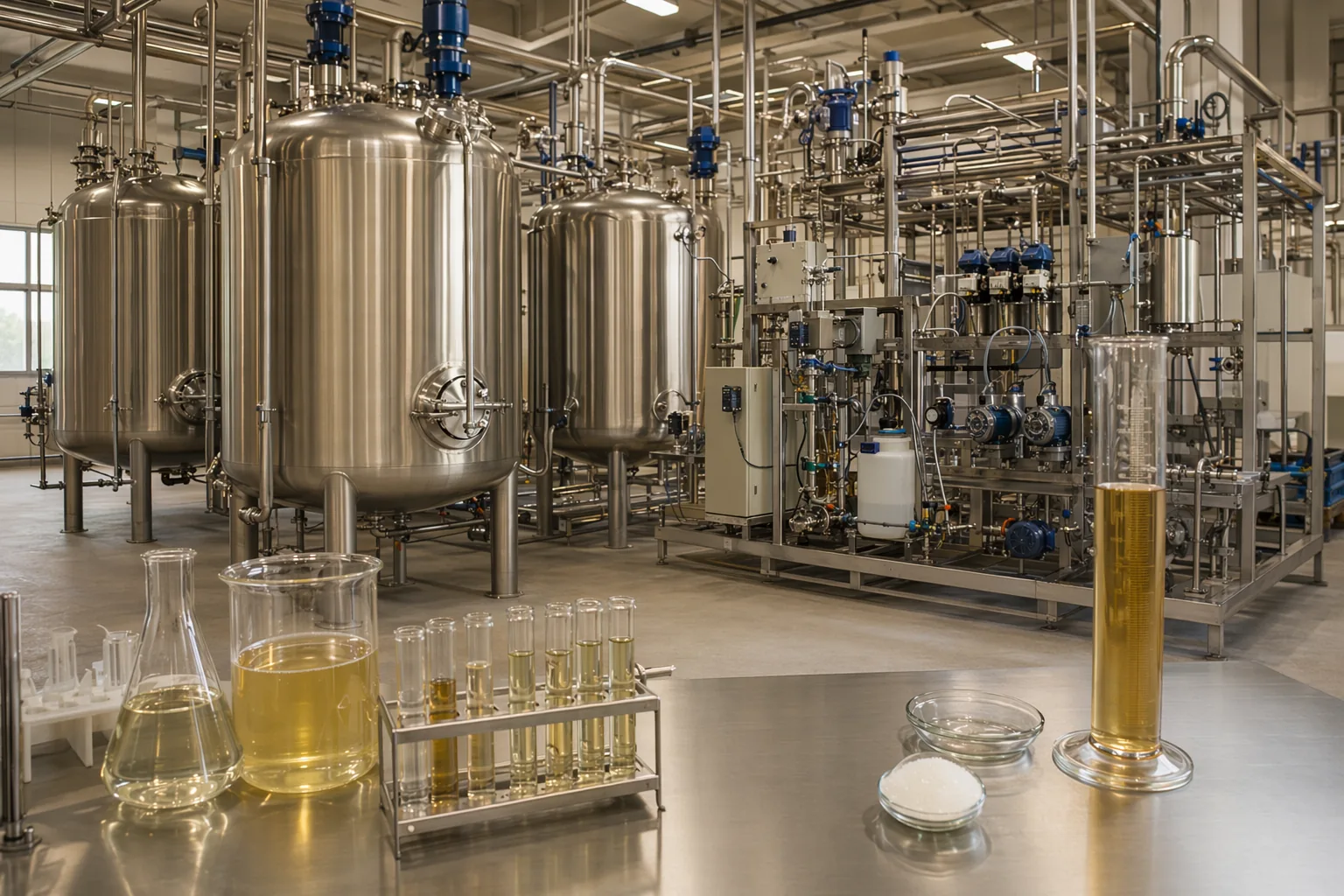
Syrup plants add a debranching step when glucose or maltose targets are missed because branched dextrins survive saccharification. This guide covers where pullulanase fits in the line, the conditions to hold, the QC that shows whether it pays, and the supply questions to settle before you request a quote.
Why Pullulanase Matters in Syrup Production
Pullulanase is an industrial debranching enzyme that targets alpha-1,6 glycosidic bonds in amylopectin and related branched dextrins. In syrup production, it is typically used after starch liquefaction, often alongside glucoamylase or beta-amylase, to improve conversion efficiency and shape the final carbohydrate profile. By opening branch points, pullulanase can support higher glucose yield, improved maltose formation, lower residual limit dextrins, and more predictable saccharification. The enzyme is not a substitute for good liquefaction; it works best when gelatinization, alpha-amylase thinning, pH adjustment, and calcium or process aids are already controlled. For B2B buyers, the right pullulanase supplier for syrup production should help translate enzyme activity into measurable plant economics, not just offer a unit price.
Application focus: starch-to-glucose, maltose, and specialty syrups • Primary function: starch debranching • Typical process stage: post-liquefaction saccharification
How Debranching Changes the Syrup Profile
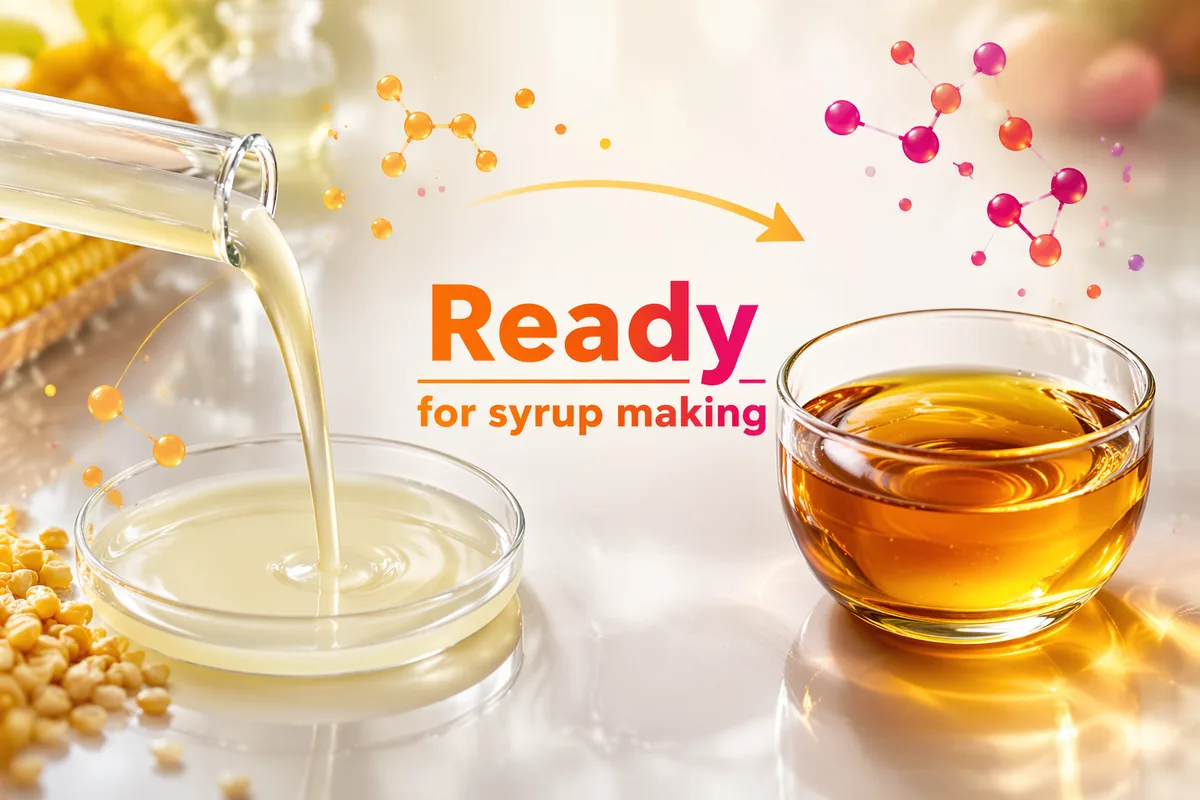
Pullulanase function is most valuable after liquefaction, when starch has been converted into dextrins that still contain branch points. These alpha-1,6 branches can limit complete saccharification if glucoamylase is used alone. By applying pullulanase with a compatible saccharifying enzyme, the process can reduce limit dextrins and improve access to fermentable or sweetening sugars. For glucose syrup, the goal may be higher DE and lower residual oligosaccharides. For maltose syrup, pullulanase can support a higher maltose fraction when paired with beta-amylase under controlled conditions. The effect of pullulanase on gel strength of starch is more relevant to modified starch and food texture systems, but the same debranching chemistry explains why viscosity and retrogradation behavior may change during starch conversion. In syrup production, the buyer should focus on sugar spectrum, viscosity, filtration, evaporation load, and final syrup specification rather than texture claims alone.
Reduces branched limit dextrins. • Supports glucose or maltose target profiles. • Can influence viscosity and downstream handling.
Recommended Process Window
Most industrial pullulanase enzyme for syrup production is evaluated in the saccharification step, where temperature, pH, and residence time must match the full enzyme blend. This grade works at pH 4.0–5.5 and 55–65 °C; check that window against your glucoamylase program for glucose syrup, or against beta-amylase compatibility for maltose-oriented syrup. Dry solids depend on starch source, viscosity, evaporator capacity, and filtration limits. Dosage should be set by activity units and confirmed against the supplier TDS; as a practical screening band, processors may test several levels around the recommended dose rather than assuming one universal rate. The endpoint should be defined by sugar profile and DE, not clock time alone.
Control pH before enzyme addition • Avoid overheating during saccharification • Screen dosage by activity, not only product weight • Confirm compatibility with glucoamylase, beta-amylase, and process aids
QC Checks for Pilot and Plant Trials
A pullulanase for syrup production trial should begin with a defined control batch and a documented enzyme addition plan. Key analytical checks include DE, glucose or maltose percentage, DP2/DP3 distribution, residual dextrins, viscosity, pH drift, microbial limits where relevant, filtration rate, color, ash, and final solids. HPLC carbohydrate profiling is the preferred way to see whether starch debranching is improving the target sugar spectrum. Plants should also track practical operating effects such as saccharification time, evaporator load, ion exchange behavior, filter aid use, and rework volume. When comparing an industrial pullulanase syrup production option, use cost-in-use per metric ton of syrup solids or per ton of dry starch converted, rather than purchase price per kilogram alone.
Measure DE and sugar spectrum at fixed intervals • Track viscosity and filtration behavior • Compare yield, time, and energy use • Calculate cost-in-use at production scale
Pullulanase Production and Supply Considerations
Commercial pullulanase production is usually based on controlled microbial fermentation followed by downstream recovery, standardization, and formulation. Buyers may ask suppliers how strain control, fermentation consistency, activity standardization, preservation, and batch release are managed. Research literature often discusses the production of pullulanase with different agro wastes as substrate, but industrial procurement should focus on reproducible enzyme activity, impurity control, supply reliability, and technical documentation. A dependable pullulanase enzyme supplier for syrup production should provide a current COA for each lot, a TDS with activity definition and recommended use conditions, an SDS for safe handling, storage and shelf-life guidance, and traceability information. If the supplier changes formulation, carrier, preservative system, or activity basis, the enzyme should be revalidated before routine use.
Request COA, TDS, SDS, and lot traceability • Confirm activity method and unit definition • Check storage temperature and shelf life • Ask about formulation or carrier changes
How to Qualify a Pullulanase Supplier
Supplier qualification should combine documentation review, bench testing, pilot validation, and commercial risk assessment. Start by confirming that the pullulanase product is intended for industrial food or starch processing applications and that its recommended pH and temperature match your saccharification system. Review the COA for activity, appearance, microbiological specifications where applicable, and batch identification. The TDS should explain dosage, substrate compatibility, inactivation guidance, and handling limits. During pilot validation, test at least three dosage points against your current process and measure both technical performance and cost-in-use. For an industrial pullulanase enzyme syrup production program, the best supplier is the one that can support troubleshooting, scale-up interpretation, consistent supply, and transparent change notification.
Run bench, pilot, and production confirmation trials • Validate performance on your actual starch source • Assess technical support and lead time • Document change-control expectations
Technical Buying Checklist
For a syrup line adding a debranching step:
Map the line: liquefaction, cooling and pH adjustment, then the saccharification tank where pullulanase goes in • Hold the grade’s window (pH 4.0–5.5, 55–65 °C) through the hold • Pair it with glucoamylase for glucose syrup or beta-amylase for maltose syrup, and test the ratio • Sample DE and the HPLC sugar spectrum at fixed intervals against a control • Check evaporator load, filtration and color before scale-up • Agree acceptance criteria and change-notification terms before the first order
Request a Quote
Glucose and maltose syrup producers, distributors and resellers: send the product, the quantity and the destination. Pullulanase ships as a brown liquid in 25 kg drums or 200 L drums, minimum order 25 kg, and is quoted per order. Add your syrup target and current saccharification enzymes if you want the offer matched to your line.
Pullulanase (Debranching Enzyme) for Research & Industry
Need Pullulanase (Debranching Enzyme) for your lab or production process?
ISO 9001 certified · Food-grade & research-grade · Ships to 80+ countries
Frequently Asked Questions
What does pullulanase do in syrup production?
Pullulanase hydrolyzes alpha-1,6 branch points in amylopectin-derived dextrins after starch liquefaction. This debranching allows glucoamylase or beta-amylase to access more linear chains, which can improve glucose or maltose formation and reduce residual limit dextrins. The result depends on starch source, liquefaction quality, pH, temperature, dosage, and saccharification time.
How should we dose pullulanase enzyme for syrup production?
Dose should be based on the supplier’s declared activity units and validated in your own process. A practical approach is to run bench or pilot trials at low, recommended, and high dosage points while measuring DE, HPLC sugar profile, viscosity, filtration, yield, and cost-in-use. Avoid converting dosage only by product weight unless activity and formulation are equivalent.
What should we ask a pullulanase supplier for syrup production?
Ask for a current COA, TDS, SDS, activity method, unit definition, storage conditions, shelf life, batch traceability, and recommended pH and temperature range. Also request guidance on compatibility with glucoamylase, beta-amylase, calcium, preservatives, and process aids. A qualified supplier should support pilot validation and notify customers about meaningful formulation or activity changes.
Can pullulanase reduce syrup production cost?
It can, but the economics must be proven in your plant. Pullulanase may improve conversion, reduce residual dextrins, shorten saccharification, or improve filtration in some systems. The correct comparison is cost-in-use per ton of dry starch or syrup solids, including enzyme spend, yield, time, energy, filtration, rework, and downstream processing effects.
Does pullulanase affect gel strength of starch?
The effect of pullulanase on gel strength of starch depends on starch type, degree of debranching, solids, cooling profile, and formulation. Debranching can change chain-length distribution, which may influence gelation and retrogradation. However, syrup production trials do not directly prove gel strength performance. If gel strength is a requirement, run separate rheology or texture testing under the intended food or industrial starch conditions.
Turn This Guide Into a Supplier Brief
Request a pullulanase evaluation pack with COA, TDS, SDS, and pilot trial support for your syrup production line. See our application page for Pullulanase for Measurable Process Gains for specs, MOQ, and a free 50 g sample.
Contact Us to Contributehello@mail.enzymeimpact.com