Pullulanase Industrial Applications: Formulation Guidance for Starch Processing
Practical pullulanase formulation guidance for starch processors: pH, temperature, dosage, QC, pilot validation, and supplier checks.
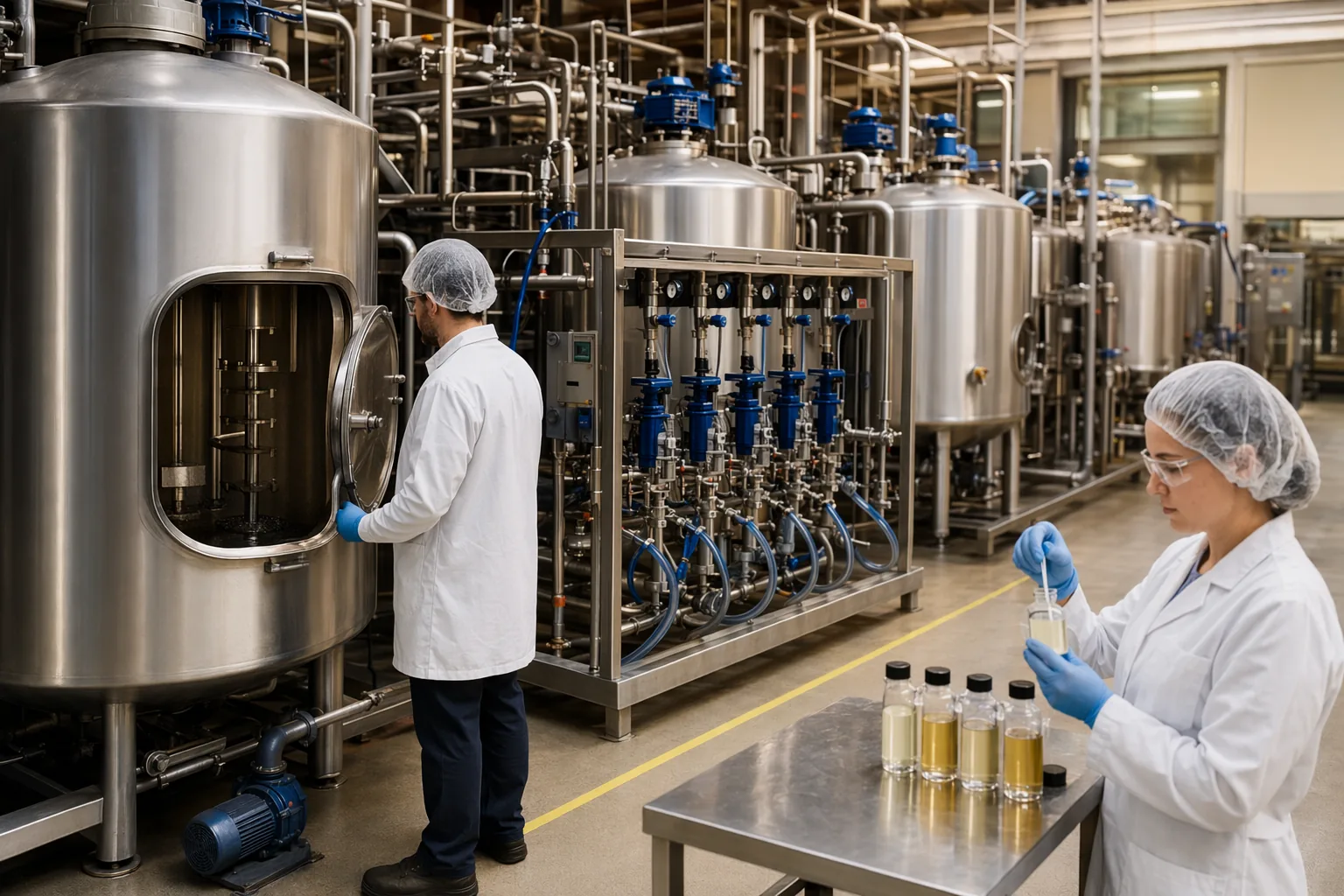
Pullulanase is a debranching enzyme used to improve starch conversion, increase fermentable sugar profiles, and support efficient syrup production when validated under real plant conditions.
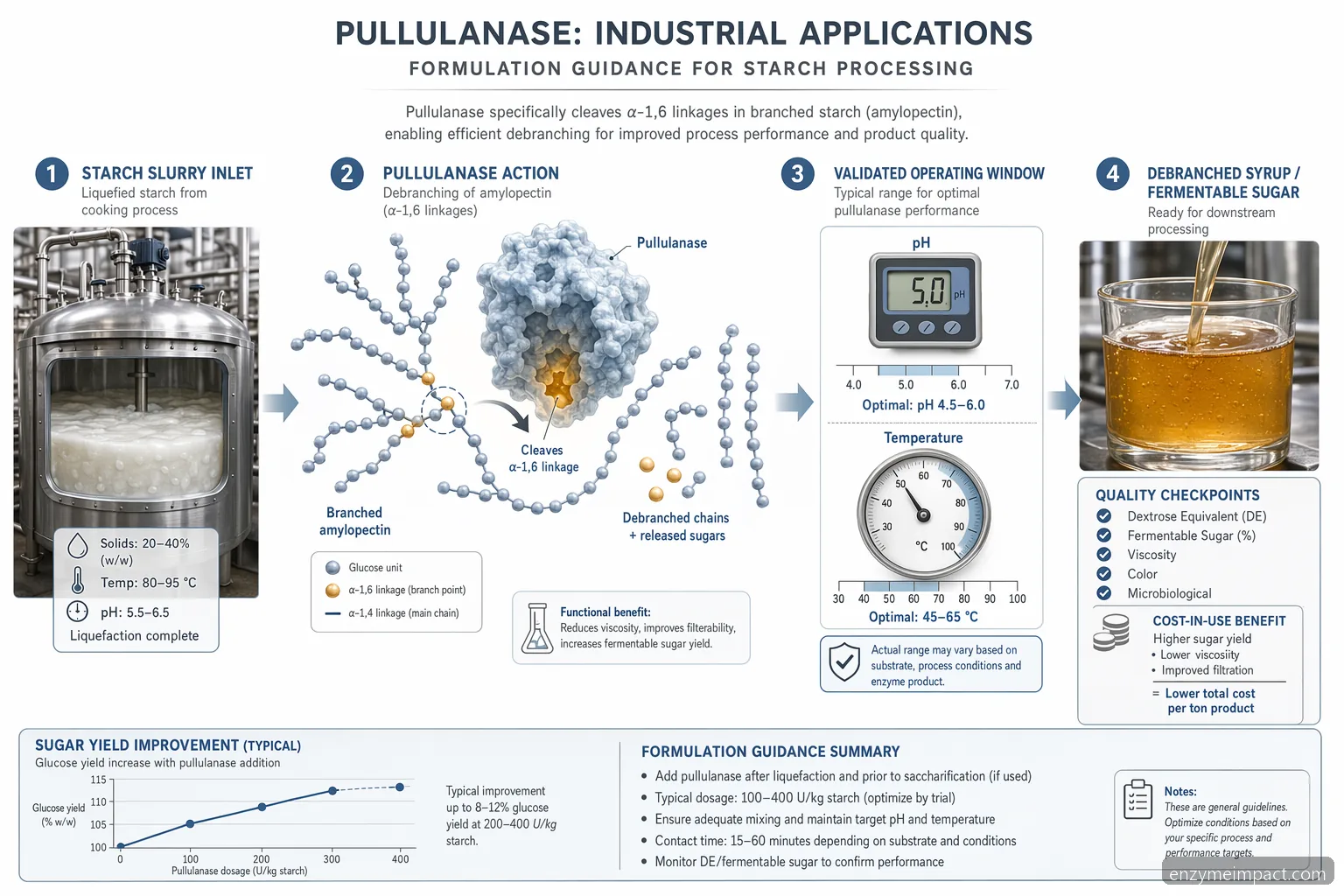
What Pullulanase Does in Industrial Starch Conversion
Pullulanase is a starch debranching enzyme that hydrolyzes alpha-1,6 glycosidic linkages in pullulan, amylopectin, and branched limit dextrins. In pullulanase industrial applications, this action complements alpha-amylase, glucoamylase, beta-amylase, and fungal amylase systems by opening branched structures that otherwise slow conversion. For starch processors, the main value is not simply faster hydrolysis; it is tighter control of sugar distribution, lower residual dextrin, and improved conversion efficiency when process conditions are aligned. In syrup production, pullulanase can support higher glucose, maltose, or fermentable extract profiles depending on the companion enzyme system. In brewing, it may be used to reduce limit dextrins and adjust fermentability, subject to recipe and regulatory requirements. For B2B formulation work, pullulanase should be treated as a process enzyme with defined activity, stability, and compatibility limits, not as a one-size-fits-all additive.
Primary function: starch debranching • Key substrate structures: amylopectin and limit dextrins • Common partners: glucoamylase, beta-amylase, alpha-amylase • Main outputs: controlled saccharification and improved sugar profile
Where to Add Pullulanase in Starch Processing
Industrial pullulanase enzyme starch processing usually begins after starch slurry liquefaction. A typical process uses alpha-amylase to liquefy starch at high temperature, then cools and adjusts pH before saccharification. Pullulanase is commonly added during saccharification with glucoamylase for glucose syrup or with beta-amylase and other amylolytic enzymes for maltose-rich syrup. The best addition point depends on substrate viscosity, liquefaction quality, enzyme compatibility, and residence time. If pullulanase is added too early, thermal or pH stress may reduce effective activity. If added too late, the enzyme may not have enough contact time with branched dextrins to influence the final carbohydrate profile. Process trials should compare single-point dosing, staged dosing, and combined enzyme dosing to determine the most economical approach. Formulators should also confirm whether preservatives, antifoams, salts, or cleaning chemical residues interfere with enzyme performance.
Add after liquefaction for most syrup processes • Avoid high-temperature exposure outside the enzyme TDS range • Validate compatibility with companion enzymes • Check pH adjustment accuracy before enzyme dosing
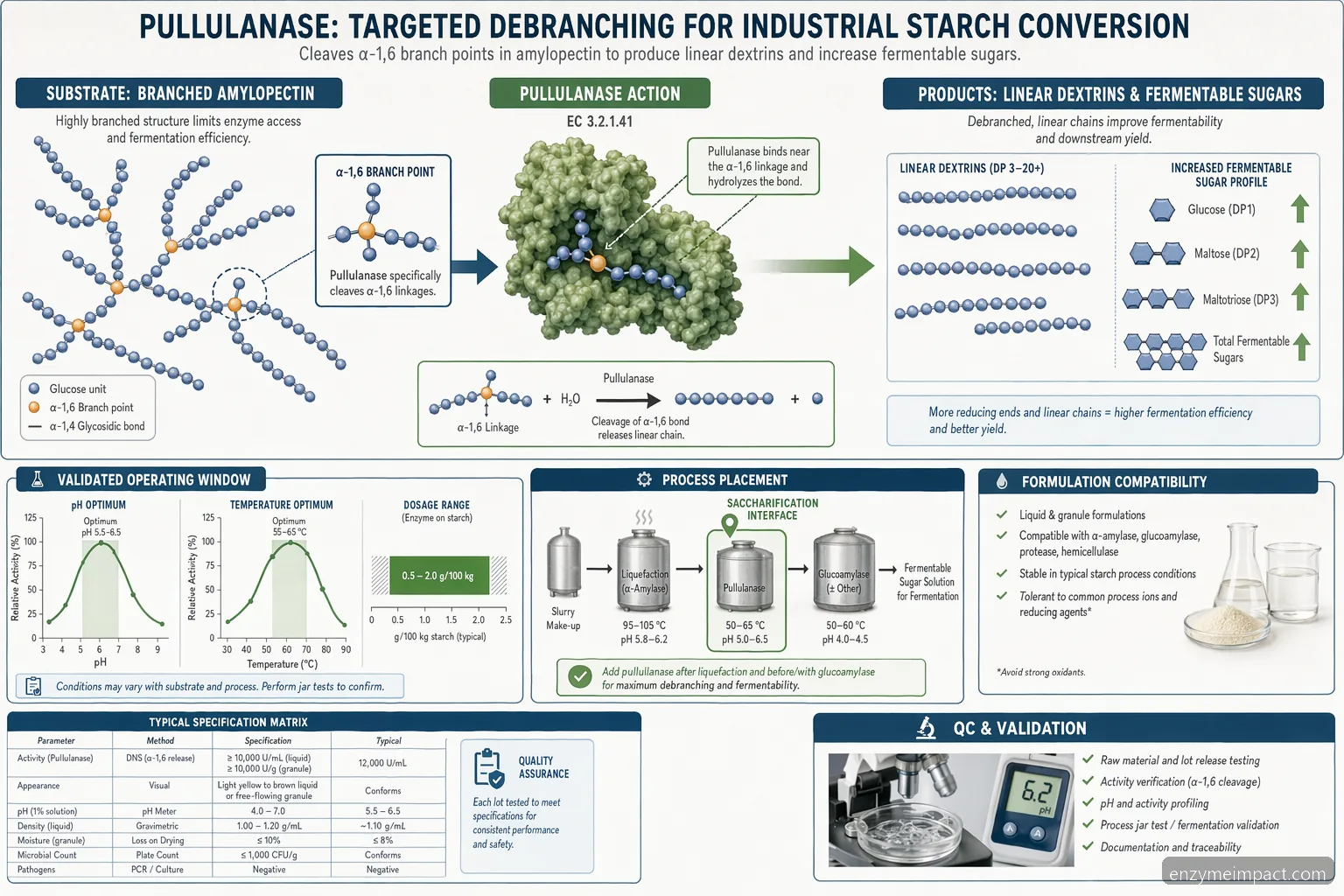
Practical pH, Temperature, and Dosage Ranges
For many commercial pullulanase preparations, practical saccharification conditions fall around pH 4.0-5.5 and 55-65°C. Some grades are optimized outside this band, so the supplier technical data sheet should be the controlling document. A common evaluation range for industrial pullulanase syrup production is 0.05-0.60 kg enzyme preparation per metric ton of starch dry solids, or an equivalent activity-based dosage specified by the supplier. Activity-based dosing is preferred because products can differ significantly in enzyme strength, stabilizers, and formulation concentration. Residence time often ranges from several hours to more than 24 hours depending on syrup target, dry solids, substrate, and enzyme package. Use bench trials to map dose response at realistic Brix, pH, temperature, and agitation. The goal is not maximum enzyme addition; it is the lowest cost-in-use that consistently delivers the target DE, DP distribution, filtration behavior, and yield.
Typical pH screen: 4.0, 4.5, 5.0, 5.5 • Typical temperature screen: 55, 60, and 65°C • Evaluate dosage by activity and dry solids • Optimize for cost-in-use, not maximum conversion alone
Formulation and Compatibility Considerations
A pullulanase formulation must remain stable during storage, dosing, and contact with the process stream. Liquid enzyme preparations should be stored within the supplier’s stated temperature range, protected from repeated freeze-thaw cycles, and handled with clean dosing equipment. In starch plants, compatibility risks include extreme pH adjustment, excessive heat, oxidizing sanitizers, heavy metal contamination, and unexpected dilution water quality. When using pullulanase with glucoamylase, beta-amylase, fungal amylase, or protease, confirm that the recommended pH and temperature windows overlap. If the process requires high dry solids, check mixing efficiency because localized pH or temperature gradients can reduce enzyme performance. Formulators should also review whether the product contains carriers, stabilizers, or preservatives that affect customer specifications. For industrial pullulanase enzyme syrup production, the enzyme package should be evaluated as a system because changing one enzyme can shift viscosity, saccharification rate, filtration load, and final sugar composition.
Confirm storage and shelf-life conditions • Avoid oxidizing chemical carryover • Check overlap with companion enzyme operating windows • Validate performance at production dry solids
Quality Control Checks for Production Validation
Pullulanase applications should be validated with measurable process and product data, not only with visual liquefaction or endpoint assumptions. In syrup production, common QC checks include pH, temperature profile, dry solids, DE, reducing sugars, HPLC carbohydrate profile, residual starch or iodine response, viscosity, filtration rate, color, ash, and microbiological status where relevant. For fermentation or brewing-related use, monitor fermentability, attenuation, real extract, alcohol yield, and sensory impact as applicable. During pilot validation, compare a control batch without pullulanase against multiple dosage levels and addition strategies. Track performance across corn, wheat, tapioca, potato, or mixed starch substrates because amylopectin structure and liquefaction behavior can change enzyme demand. Production teams should document hold times, agitation, actual enzyme addition mass, lot numbers, and deviations. This creates the evidence needed for scale-up, purchasing approval, and supplier performance review.
Use HPLC to confirm DP and sugar distribution • Measure DE and residual starch trends • Track viscosity and filtration effects • Document enzyme lot and process deviations
Supplier Qualification and Cost-in-Use Evaluation
For industrial pullulanase enzyme starch processing, supplier selection should include technical, quality, commercial, and logistics criteria. Request the certificate of analysis, technical data sheet, safety data sheet, allergen or food-contact statements where applicable, recommended use levels, activity method, storage conditions, and shelf-life information. Do not rely only on price per kilogram because enzyme concentration and process response can differ. Cost-in-use should account for dosage, yield change, energy impact, residence time, filtration behavior, rework reduction, and consistency of the final syrup specification. Buyers should also evaluate batch-to-batch activity control, packaging options, lead time, cold-chain needs if any, technical support, change notification practices, and sample availability for pilot trials. A qualified supplier should help define a validation protocol without making unsupported guarantees. The best commercial choice is the pullulanase that delivers repeatable specification compliance at the lowest validated total process cost.
Request COA, TDS, and SDS before trials • Compare suppliers by activity and performance • Run pilot validation before plant adoption • Calculate total cost-in-use, not unit price only
Technical Buying Checklist
Buyer Questions
Pullulanase is used to debranch starch-derived dextrins by hydrolyzing alpha-1,6 linkages. This makes branched amylopectin fragments more accessible to saccharifying enzymes such as glucoamylase or beta-amylase. In industrial pullulanase starch processing, the result may be improved conversion, lower residual dextrin, or a more controlled glucose or maltose profile, depending on the total enzyme system and process conditions.
Many industrial pullulanase products are evaluated around pH 4.0-5.5 and 55-65°C during saccharification. However, the exact operating window depends on the enzyme source, formulation, and declared stability. Processors should follow the supplier TDS, then run bench and pilot trials at actual dry solids, residence time, and substrate quality before setting final plant conditions.
A practical screening range is often 0.05-0.60 kg enzyme preparation per metric ton of starch dry solids, but activity-based dosing is more accurate. Dosage should be optimized against DE, HPLC sugar profile, viscosity, filtration, residence time, and cost-in-use. The lowest dose that consistently meets specification is usually preferable to excessive dosing that adds cost without meaningful process benefit.
Yes. Pullulanase is commonly paired with glucoamylase for glucose syrup production and with beta-amylase or fungal amylase systems for maltose-rich syrups. The key is compatibility: the enzymes must share workable pH and temperature conditions, and the process must allow sufficient residence time. Trials should compare companion enzyme ratios because debranching can shift the carbohydrate profile and conversion rate.
Industrial buyers should request a certificate of analysis, technical data sheet, safety data sheet, activity method, recommended dosage range, storage conditions, shelf-life, and relevant food or processing suitability statements for the target market. Supplier qualification should also include sample availability, pilot support, lot consistency, lead time, packaging options, and change notification practices before routine production use.
Related Search Themes
pullulanase applications, industrial pullulanase syrup production, industrial pullulanase starch processing, industrial pullulanase enzyme syrup production, industrial pullulanase enzyme starch processing, industrial pullulanase enzyme brewing
Pullulanase (Debranching Enzyme) for Research & Industry
Need Pullulanase (Debranching Enzyme) for your lab or production process?
ISO 9001 certified · Food-grade & research-grade · Ships to 80+ countries
Frequently Asked Questions
What is pullulanase used for in starch processing?
Pullulanase is used to debranch starch-derived dextrins by hydrolyzing alpha-1,6 linkages. This makes branched amylopectin fragments more accessible to saccharifying enzymes such as glucoamylase or beta-amylase. In industrial pullulanase starch processing, the result may be improved conversion, lower residual dextrin, or a more controlled glucose or maltose profile, depending on the total enzyme system and process conditions.
What pH and temperature should be used for pullulanase?
Many industrial pullulanase products are evaluated around pH 4.0-5.5 and 55-65°C during saccharification. However, the exact operating window depends on the enzyme source, formulation, and declared stability. Processors should follow the supplier TDS, then run bench and pilot trials at actual dry solids, residence time, and substrate quality before setting final plant conditions.
How much pullulanase should be dosed in syrup production?
A practical screening range is often 0.05-0.60 kg enzyme preparation per metric ton of starch dry solids, but activity-based dosing is more accurate. Dosage should be optimized against DE, HPLC sugar profile, viscosity, filtration, residence time, and cost-in-use. The lowest dose that consistently meets specification is usually preferable to excessive dosing that adds cost without meaningful process benefit.
Can pullulanase be used with glucoamylase or beta-amylase?
Yes. Pullulanase is commonly paired with glucoamylase for glucose syrup production and with beta-amylase or fungal amylase systems for maltose-rich syrups. The key is compatibility: the enzymes must share workable pH and temperature conditions, and the process must allow sufficient residence time. Trials should compare companion enzyme ratios because debranching can shift the carbohydrate profile and conversion rate.
What documents should buyers request from a pullulanase supplier?
Industrial buyers should request a certificate of analysis, technical data sheet, safety data sheet, activity method, recommended dosage range, storage conditions, shelf-life, and relevant food or processing suitability statements for the target market. Supplier qualification should also include sample availability, pilot support, lot consistency, lead time, packaging options, and change notification practices before routine production use.
Related: Pullulanase for Measurable Process Gains
Turn This Guide Into a Supplier Brief Request pullulanase samples, COA/TDS/SDS review, and pilot-scale formulation support for your starch processing line. See our application page for Pullulanase for Measurable Process Gains at /applications/pullulanase-debranching-enzyme/ for specs, MOQ, and a free 50 g sample.
Contact Us to Contribute